
 Back to 10 years
A world-class ecosystem
Analysis and prospects of the Latin American BIO Startup Ecosystem
We like working with data. It guides and inspires us. It allows us to challenge our intuitions in order to discard them, refine them, or even emphasize them.
It also allows us to back up and bring precision to bold statements like “Latin America’s venture-backable bio startup ecosystem could metabolize between 2.6 and 5.5 billion dollars over the next 10 years.” But let’s not get ahead of ourselves.
Since the beginnings of GRIDX, we have tried to collect, structure, and even actively seek out—when unavailable—data that would guide us in the strategy and tactics of what we do. Numbers such as how many scientists our region has, how scientific capabilities are distributed across different disciplines, how they are spread regionally, how much of that science can be relevant to creating companies with an attractive profile for the venture capital industry, how much of that science can be competitive, and so on.
All of this from a vision of building a regional ecosystem. An ecosystem of science-based companies that can, from here, project themselves out to the world. But since that ecosystem includes not only companies but also other organizations focused on understanding, promoting, and accelerating bio development in Latin America, we partnered with the teams from the Latin American Dynamism Project (LADP) and El Gato y La Caja to pool the experience and capabilities we needed. The goal was (and still is) to conceptualize, frame, obtain, clean and develop methodology for analyzing ecosystem data, and effectively processing it in a way that would allow us to answer the question of how big this opportunity is, or at least, model some possible futures for the development of bio frontier technology startups in our region.
This is what we learned:
In the last decade, this ecosystem was born and grew, and according to our most recent records, today there are about 400 companies born in Latin America specializing in life sciences that have already gone through VC processes or are designed to connect with that financing market.
So, with the goal of understanding this particular ecosystem and its future potential, we identified that the first challenge was to build a dataset allowing us to present a solid idea of how this ecosystem could grow in the coming decade.
Within our region, much of that information did not exist, and we built it along the way. And although there is still a long way to go, today we have a fairly broad and deep understanding of how we can navigate that path. An understanding that is, above all, original, given that no other organization (public, private, or multilateral) has aggregated information or an analysis of this kind regarding the concrete possibilities our region has to create companies capable of projecting themselves into global competition.
That is also why we chose to share this information, so it can serve as a new point of friction and analysis for this very ecosystem.
What we learned
In Latin America, when we speak of science-based companies, we are overwhelmingly talking about bio. According to the latest BIDLab report from 2023, 61% of deeptech startups in our region were classified as biotechnological. This makes sense because our region’s scientific system is primarily related to life sciences in their multiple applications. According to our estimates, between 60% and 65% of the region’s science is related to life sciences.
In order to organize this conversation, it is first important to clarify what we mean when we talk about biotechnology. The Boston biotech pharma ecosystem is not the same as the needs and companies emerging to bring new biological solutions to agriculture or food. The type of ecosystem for industrial biological solutions, which do not require regulatory processes, is also different. Another discussion altogether is when we speak of technologies providing the infrastructure for the biotech industry: biomanufacturing tools, genomic sequencing, AI platforms for bio, etc.
Now, we know that every ecosystem builds dynamics with its own trajectories, similar to themselves, whether in Europe, the United States, or China (to name the three most important ones). Some ecosystems are more geared towards health segments, others towards industry; some are more mature, others less so. What we did suspect is that the behavior of the companies actively participating in those ecosystems—all with about a decade more development than ours—would bear enough similarities to ours to teach us about our possible future. Or, at least, that is what we hoped and part of the hypotheses we later successfully tested.
When we talk about Latin America’s biotech startup ecosystem, and following the first version of the taxonomy we use at GRIDX to separate four major domains, we are talking about 40% health startups, 35% agrifood, 13% related to deep bio, and 12% to industrial solutions.
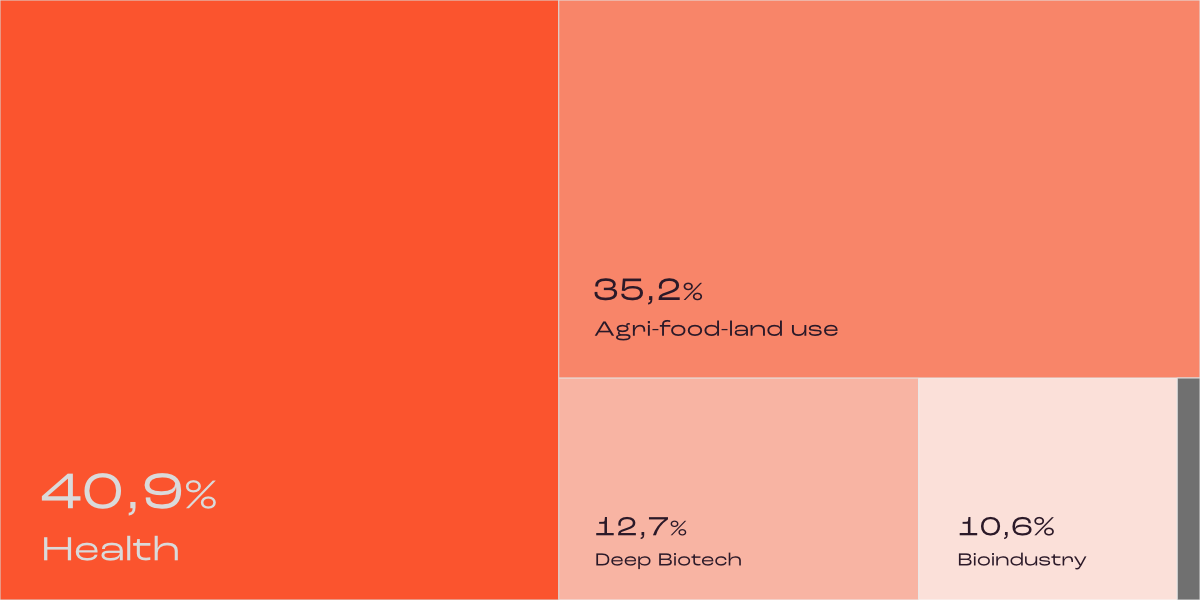
Therefore, knowing our ecosystem’s distribution, we set out to develop a database with a sectoral distribution similar to what we see in LATAM among the 386 identified bio startups, in order to contrast our own basket of projects with an equivalent one. That is how we narrowed down to over 1,250 startups worldwide with some 5,000 VC deals executed over the last 10 years.
What did we want to learn from them? Their nature. Their growth rates, their death rates, their ability to metabolize capital and how they convert it into value. So, at this point, in addition to the data itself, we began working on the methodological approaches that best described that development, drawing ideas and models from fields ranging from finance to ecology.
The first thing we did was to understand the development trajectories of those 1,250 global startups, which we converted into cohorts and tracked over a decade of data. Thus, the story of each one became the story of its batch, and the story of the batches allowed us to understand regularities about these organisms.
This way, we were first able to identify the graduation rate between series. That is, how many startups that reached a seed round made it to a Series A, how many to a Series B, and how many to a Series C.

And secondly, the times between rounds. How long it takes a startup to reach the next investment round.

And even the median capital raised in each round.
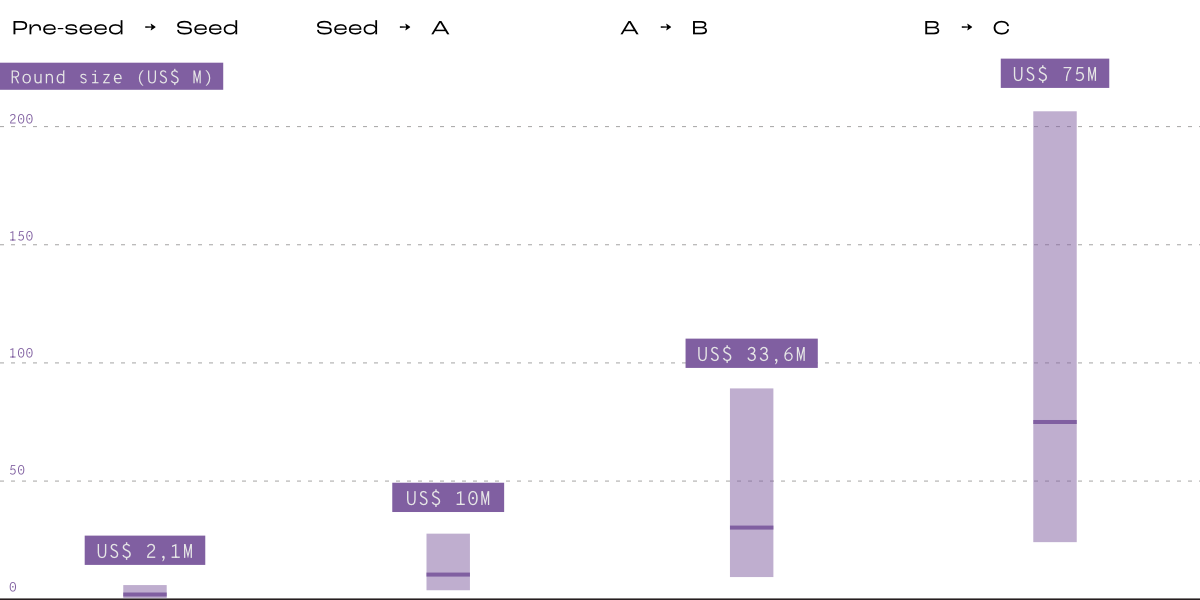
This analysis allows us to have a first global benchmark on the behavior of this type of new-generation biotech company, something that did not exist until now. But the value only begins there, because we were looking for something else: to identify regularities that would help us compare what is happening in our region. Before achieving this, a question arose: can we compare this data with the LATAM base to thus project its future possibilities? Once again, it was time to turn intuitions into data-testable hypotheses.
Our assumption at the start of this project (that of establishing a benchmark, but also that of GRIDX’s own creation) was and still is that the LATAM ecosystem is world-class. We defend this conviction because we have been observing it for 10 years, seeing how dozens of bio companies from our region go out into the world to compete for markets and capital.
But we have worked long enough with scientists and other data professionals to know that intuition and experiment are different degrees of certainty. So we went to the only possible overlapping point: the available data we have on LATAM bio startups that are now in the timeframe to cross the stage between their seed round and Series A. The only overlapping stage between our Latin American dataset and the non-Latin American one.
The most important insight was that, as far as we can measure today, both the graduation curve between the seed and A series and the median time between them are not statistically distinguishable between the two groups. Our young ecosystem seems indistinguishable from the global one in its capacity to grow and develop. Are there fewer data points than we would like? Sure. Do we need more and better data from LATAM? Sure. Will this pattern hold up later on, in the curves between Series A and B, B and C? We will find out as the local ecosystem matures. But, at least for now, the hypothesis that our local companies and those from the rest of the world have equivalent initial trajectories still stands, no longer as intuition, but as an initial analysis.
Now, to make the projection we wanted, we were still missing one piece of data. How does a startup go from its pre-seed series, from its very early incubation stage, to a first seed series that puts it on an international VC track? That is where our own data came into play once again.
The data we have from GRIDX’s own portfolio (which represents roughly a quarter of the LATAM database we built) tells us that, at the time of developing this analysis, approximately 34% of the companies founded and funded at pre-seed stages manage to raise capital in seed stages. We also know that they do so under similar round size and valuation conditions as the non-LATAM benchmark base, although we do not know precisely how many go from pre-seed to seed because that universe is not available.
So, we now have the complete cycle to project LATAM. From pre-seed to seed, data from 93 GRIDX companies. From seed to Series A, data from the non-LATAM benchmark which, as we tested, is indistinguishable from what we have in the LATAM series. From A to B and B to C we do not yet have enough data to compare the LATAM base with the global base, but we use the global data for our projection model.
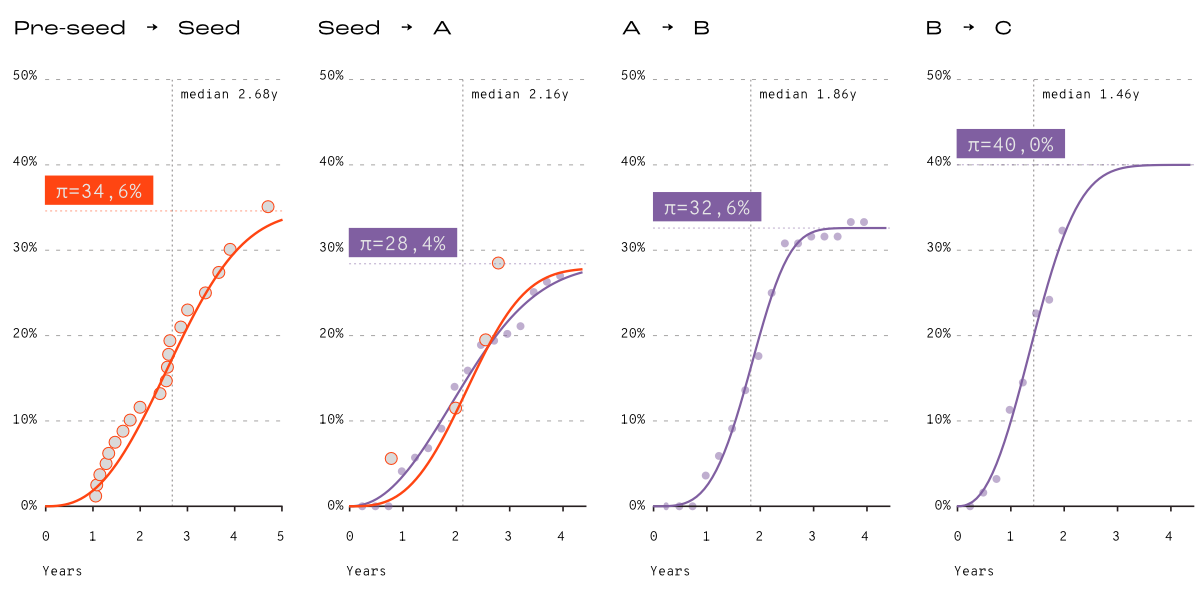
So, having built this model of expected behavior for LATAM bio startups, we set out to project it over 10 years to understand what the impact could be. True to an approach that learns from the natural world, we did not choose a deterministic model, but continued thinking of a living ecosystem, full of bugs, to which things happen. Sometimes capital droughts, but then good times come. Sometimes the friction of competition, other times the advantage of cooperation.
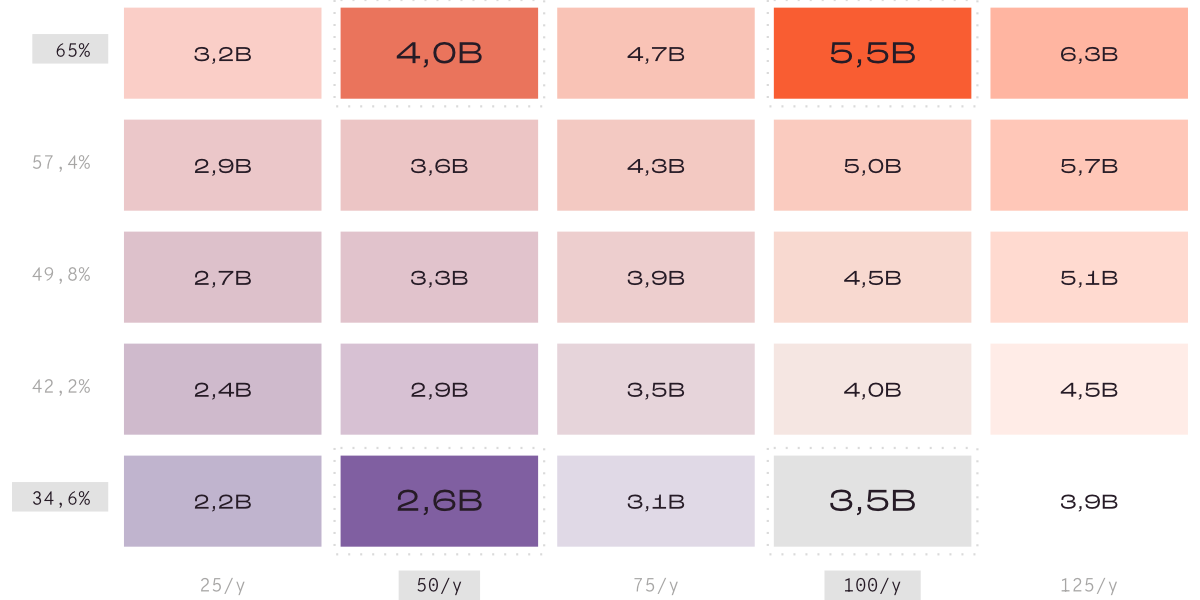
For this, we ran 10,000 simulations where every company in the region performs with those survival and graduation parameters. The result? The base case. We believe that, doing what we do today, in the next 10 years Latin America can absorb and metabolize 2.6 billion dollars in venture capital investment.
We believe that, doing what we do today, in the next 10 years Latin America can absorb and metabolize 2.6 billion dollars in venture capital investment.
But we did not want to stop at the prediction, projection, or base scenario, so to that future model based on the present as it is, we added two questions:
- What happens if, instead of the approximately 50 companies we create per year in LATAM today, we create more?
- What happens if we manage to increase that 34% graduation rate from pre-seed to seed?
Thus, we went from a purely predictive model about what could happen with our region to one that allows us to think about how far we can go by working and improving as an ecosystem.
The first question we tested is what happens if we create more companies, and we believe it is a relevant question precisely because we believe Latin America can create much more than 50 frontier bio startups per year.
The scientific system today has 200,000 life sciences researchers. We understand that the potential for creating companies is much greater and that, by scaling up, we can also improve the quality of that creation and its journey in the early years. That means: a scientific system more open to companies emerging from its cloisters, technology transfer offices with greater knowledge of venture capital and more agility for licensing technologies, providing services, or leasing infrastructure, more scientists motivated to create their companies, and more non-scientific entrepreneurs eager to join these companies.
The second arises from knowing that we ourselves—the company builders, the investors, the ecosystem accelerators—can improve and, as a consequence, improve the graduation rate from foundation to the seed round; that is, how many companies that emerged in Latin America secure seed-stage investments from institutional investors. That rate, which we currently identify at around 34%, can improve significantly if we achieve greater visibility for this ecosystem in the world and better bridges to global investors. With each passing year, this visibility is improving: there are already dozens of companies that have managed to raise capital from these global investors, outstandingly demonstrating the scientific and entrepreneurial quality these startups possess.
A point that comes up time and time again in the conversation, which we share and want to bring to the forefront, is that a sufficiently large early-stage venture capital investor ecosystem does not yet exist in Latin America to comfortably cover this seed investment stage, and therefore, it is necessary, fundamental, for companies to connect as early as possible with a global investor ecosystem. As we have observed, there are almost no cases of bio companies that have raised seed rounds (of over $2 MM) with local investors alone. In daily practice, it happens to us constantly that, when going out into the world, when comparing these startups with those emerging in Europe and the United States, investors highlight the resilience, creativity, and capital efficiency of our companies. This latter point, it is worth noting, in many cases can be up to a third of the capital in early rounds to achieve the same scientific, productive, and commercial advancements compared to US and European startups. When we said we grew just as well as the world, we fell short. We do more with less, and we are still on international pace. That too is Latin America.
Regarding this topic, it is important to highlight a point that has caused misunderstandings and debates in recent years. These companies that go out into the world from our region do not abandon our region. The facts show that practically all the companies that raised capital abroad executed that investment primarily in their countries of origin. This makes strategic sense. Being able to develop science in Latin America is much more cost-effective than in the rest of the world. And not only that: almost all scientists who want to do science and do it in their country work in academia, so the opportunity to do science outside of academia, in a startup, from their city but with the ambition to enter the cutting-edge global conversation, is an attractive offer. Even beyond the founders, companies in our region have access to a very broad and highly competitive talent pool that, despite lacking private sector experience, achieves rapid and efficient adaptation to different dynamics. The competitive advantage is not leaving, but developing outwards to the world while keeping your heart here.
If we want this ecosystem to prosper, it will have to improve its skills to connect with that global capital and the bidirectional flow of funds, knowledge, and strategic resources, since those needed for frontier development up to market maturity are not only unavailable in Latin America, but it is also not desirable to concentrate them in a single region: internationalization is also resilience and impact. This applies even in stages as early as seed rounds, where startups generally get their first institutional investors. So, considering this projection model and knowing that we can improve both qualitatively and quantitatively, we see that LATAM could metabolize more than double that base case of 2.6 billion dollars to reach 5.5 billion in the next 10 years, and between these base and high-improvement scenarios, there is a whole world worth exploring.
But is this number big, small, or what?
For starters, this is a fairly prudent estimate. Although we have not identified VC investment projection reports for the region, the last two years recorded $2.8 billion and $4.1 billion respectively. These numbers could project a cumulative total of between $40 billion and $100 billion (considering LATAM VC industry growth) for the next 10 years. So it sounds quite realistic to think that bio (out of total VC) could be between 5% and 10% in different scenarios for the next 10 years, when we expect this ecosystem to consolidate and begin having its first large rounds. Our estimate looks even more conservative if we consider that the proportion of deeptech in the US VC industry has been 20% in recent years and that percentage is projected to grow in the future.
But even in that austerity, the projection is relevant. From a regional point of view, achieving those numbers would imply more advanced capital rounds of tens of millions of dollars that would begin to consolidate deep tech companies emerging in our region and operating in our region, but with global impact.
From a global point of view, it is relevant so that LATAM begins to be on the map. For a global VC fund specialized in bio, understanding that Latin America has an ecosystem with this potential could compel it to allocate part of its investment mandate to LATAM. If that happens, they will have to dedicate resources to understanding our region and its capabilities, which, upon discovering and projecting them, will generate a positive feedback loop. More investment and more attention generate more success stories, which consolidate the ecosystem, which attracts even more capital to the region. And that is not to mention the second and third-order effects of having, on home soil, consolidated frontier technology companies that give our local productive system a sharp edge capable of generating productive differentials and capability development—no longer just technological, but productive; and to our scientific systems, an articulation that materializes the value they have been creating for decades.
Why do we think managing this information is important?
First, because we know what made it possible. In recent decades, Latin America’s scientific systems have produced a critical mass of top-quality, globally competitive scientific professionals, who are not, however, contributing to the development of our countries in the way and with the prominence that we believe they can. Furthermore, much of the science in our region is funded with public money obtained through long-term development loans from multilateral organizations. These loans are clearly not being repaid with the product that this science can generate, and that is a debt held by all the countries that can be settled, in part, by improving this articulation so that more companies emerge that will demand more talent. Imagine if we manage to project this ecosystem of companies according to what we proposed. This would require between 10,000 and 20,000 scientists working in these startups, which represents between 5% and 10% of all life sciences experts in the region. The hardest part, producing the necessary talent, has already been done. Now we need to project that talent to create a vector of development that the region could have today but is not taking advantage of.
Secondly, we are convinced that exposing this information to the world will allow our region to enter the radar of global investors more organically. Most global investors specialized in biotechnology (in its different applications, from health to industrial biotech or agrifood systems) do not consider LATAM a source of startup deal flow to invest in by default. Even though there are dozens of cases that already demonstrate this LATAM potential, there is no proactivity from these investors in considering the region as an opportunity. Expressing this order of magnitude of potential capital demand allows global investors to start considering the region as a relevant sourcing opportunity. If this happens, they may include quotas for LATAM in their investment mandates and, if that happens, they will have to dedicate resources to approaching this ecosystem.
Finally, over the past 10 years, this ecosystem was born and grew. We built it as it happened, and even so, it demonstrated all the potential we imagined. Building strong arguments to project this potential allows us to participate in shaping the conversation, not just follow it on the terms others set, and also to generate a common base of knowledge and strategic analysis thanks to which we can increasingly understand and articulate our ecosystem and work all together on this grand, historical opportunity our region has. The opportunity to join a major technological revolution that will transform the way we produce and in which our region can participate outstandingly.
This work constitutes a preliminary benchmarking analysis of the bio ecosystem in the region. We are currently moving forward with the development of a more robust and comprehensive report. If you are interested in evaluating a strategic alliance to enhance this model and expand its reach, please contact us.
Credits and authorship:
- Original idea and initial database: GRIDX
- Data analysis: LADP
- Methodological development: El Gato y La Caja

Subscribe and get more insights from a decade building in bio.
© Grid Exponential
All rights reserved.
Teodoro García 2474, Buenos Aires, Argentina