
 Back to 10 years
Science lives in the team
Ten years of learning to build companies around teams doing science
When we started GRIDX, we had an ambitious yet messy question that, after much effort, we managed to define with clarity—what Latin American science produced world-class companies with global impact that we can invest in?
To answer it, we toured laboratories and universities, spoke with researchers, and mapped hundreds of projects. It turned out there was science to spare. What was almost nowhere to be found were investable companies. That absence first changed our plan, but, more profoundly, it changed our question.
We had envisioned creating a fund to back science-based startups, only to discover that, to do so, someone first had to help those startups come into existence. Who was the subject of that “had to”? We weren’t sure, but the void was so evident, the need so immense, and our vision so compelling, that we decided to take ownership. It was no longer “someone has to,” but “we have to.”
To invest in these companies, we decided that we had to take part in building them. That meant starting by understanding how to turn the promising research of a team committed to bringing it to the world into something the world actually wants.
Second iteration of the question. But we were still missing one extra twist. We had moved from the what to the how, but real clarity arrived when we shifted from the how to the who. We didn’t need to turn top-tier scientific research into something the team could bring to the world; we had to learn and answer how to guide the team through a self-transformation process to turn that research into world-class, global-scale solutions.
Ten years later, that remains one of our core questions. In the previous posts of this series, we discussed biology as the foundation of a technological and productive disruption, and how to better assess what the Latin American ecosystem can contribute to it. This post focuses on the key players who make all of that actually happen: a small group of people who decide to found a company.
Viewed from the outside, it is usually narrated like routine paperwork. A technology is found, a company is incorporated, funding is sought. Everything in the passive voice, overlooking the fact that what truly matters is left out of that description.
It leaves out how indispensable it is to assemble a core team that includes someone from a radically different world than your own, because without that diversity of thought and capabilities you get nowhere. That you will have to choose a single application among infinite possibilities, which means letting go of a thousand ideas to cultivate just a handful. And that it involves taking on tasks for which neither a scientific, technical, nor business background prepares you.
It turns out that you learn to build by building, and an entrepreneur is defined by the doing. The verb. You are not born one—you only become one. No course, workshop, YouTube video, or motivational talk can grant you embodied knowledge. You don’t learn to swim by watching a PowerPoint.
We call our approach to supporting this process founder-centric. What follows is what we have learned, along with a few things we still haven’t figured out how to solve.
What lives beyond discovery
Scientific research is sometimes the open door to a technological application, but above all, it puts something in place that is far harder to show in a pitch deck: people who know how to do things that virtually no one else can. People who know, in an ultra-specific and specialized domain, what questions to ask, how to design the experiment that answers them, and how to interpret a result that to anyone else would just be a pile of data. And they don’t just know repeatable, documentable theory. They also possess subtle, invisible craft. They know how to handle an animal delicately because its immune response depends on it. They know when and how to water a plant they are trying to turn into a miniature biofactory. They know that a day of extreme heat or cold alters the pace and quality of any microbial culture. They know that biology as a technological substrate has its own quirks and complexities that resemble nothing else, and they know how to navigate them.
That capability carries immense weight because the path from lab to product is riddled with new questions. A molecule works in the lab, yet no one knows what happens when changing scale or context. A process yields good results, but that doesn’t mean it can be executed at a price anyone is willing to pay. What works in silico sometimes fails in vitro, which sometimes fails in vivo, which sometimes fails at scale, which sometimes fails in the field, which sometimes fails economically, which sometimes fails to match the user you had in mind, which sometimes simply doesn’t work in the world as it is.
The paper and the patent are part of the journey, but they fall short. The team must continue generating knowledge long after publishing and filing. That is why, when we evaluate a project, we care about what it has already accomplished and, even more so, whether it knows—or can learn—what to do with what it doesn’t know yet.
This adds nuance to a rule the startup world repeats like a commandment: start with the problem, talk to customers. That works—and works well—outside of deep tech. But in frontier science, a customer who intimately understands a problem often has no knowledge of the tools that could solve it. How could we ask them to imagine them? If they could imagine it easily, it wouldn’t be frontier science or technological disruption. A farmer knows what lost yield in degraded soil costs. The fact that extremophilic microorganisms exist to tackle that issue is known by an entirely different group of people. The opportunity emerges when those two forms of knowledge meet.
Puna Bio, one of the companies from our early cohorts, works with extremophile microbes from the Andes to apply them to agriculture. Between that capability and a product a grower actually wants to use lay years of work that no publication can resolve—and that work is company building.
Stämm, from our first cohort, started out developing brewer’s yeast and evolved to create the world’s first 3D microfluidic bioreactor manufacturable at scale, capable of decentralizing biologics manufacturing. They began thinking about beer, and their capabilities, vision, and ambition led them to operate on the frontier of biopharma production—spanning everything from producing monoclonal antibodies to manipulating and transforming cells with efficiency, speed, and (if I may say so) elegance, creating biology-specific AI models, and empowering other teams to innovate using their platforms.
We like to study these journeys because each one is unique, yet the ones that succeed share a common pattern. Success stories consistently feature teams that learn continuously and rapidly, navigating uncertainty while seizing the opportunities the world puts in front of them.
The initial application can change along the way. In fact, it rarely stays the same—it usually shifts. So can the market, or the route to market. If the scientific capabilities remain within the team, the company has the raw materials to pivot. That is what we care most about safeguarding: ensuring the team can keep learning when the initial plan fails—and it always fails.
Before a startup, a decision
Our process is structured into three stages: Discover, Transform, and Grow. The names help organize the work.
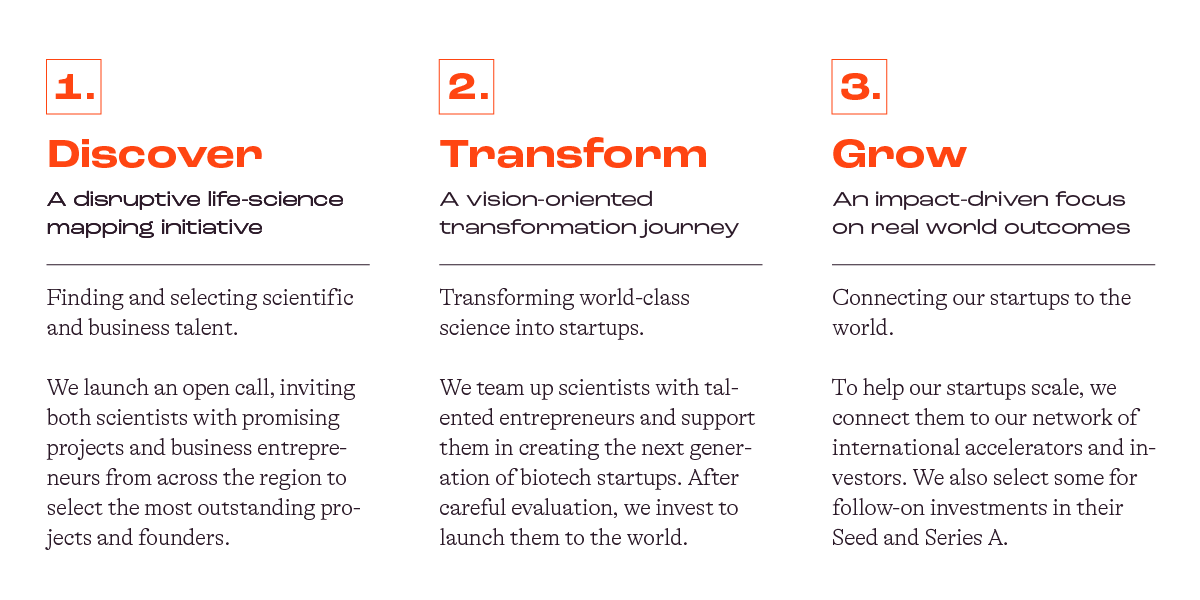
We recognized early on that a significant portion of scientific talent with entrepreneurial potential remains inside laboratories and universities, and they won’t knock on our door on their own. You have to go find them.
That is why we actively scout on an ongoing basis. We visit institutes, talk with researchers, and try to understand what they are investigating and what they want to do with it. Over the last 10 years, we have done this with thousands of researchers across the region, from northern Mexico down to Argentine and Chilean Patagonia. In parallel, we look for operators with business experience and an entrepreneurial drive who want to jump into building science-based companies. It is out of that fundamental, minimal combination of backgrounds that the teams we back emerge.
A researcher can—and often does—spend years generating knowledge without ever considering that founding a company is a viable way to continue their scientific career. Sometimes all it takes is meeting someone who has already done it, or finding a conversation partner who takes the possibility seriously, for that idea to take root.
Then comes a decision that takes time. A startup demands attention, learning, and commitment for years, and we learned that it pays to set that expectation from day one: what does each person want to build? What role will the company play in their life? What responsibilities are they willing to shoulder? We look for founders with the courage to align their life’s work with an ambitious vision of impact. Being a scientist-entrepreneur means being fully a scientist, yes. But it also means being fully an entrepreneur.
Enthusiasm for a technology is enough to get started. Sustaining years of work requires that ambition to hold a genuine place in the lives of those driving it. That is why our work begins long before the first round, when someone decides they want to pursue this, or is at least committed to earnestly exploring that ambition.
Team chemistry takes work, too
Pairing a scientist (or scientific team) with a business profile seems like the obvious answer, but getting them to build something together is much harder. Each arrives with their own background, biases, criteria for what counts as progress, and expectations around timelines. You can share enthusiasm for a technology only to discover months later that each was envisioning an entirely different company—and the most challenging part is that this divergence is not a bug, it’s a feature. If either profile could bring the project into the world on their own, they would. They can’t.
That is why this match requires collaborative, complementary work and harnessed friction. During the selection phase, scientists and business founders develop value propositions and explore the technological potential while getting to know each other, a process that takes months. Over time, you see how they operate when they actually have to produce something together.
The tasks themselves serve as a stress test. Choosing a first application forces priorities onto the table. Debating what evidence is required before speaking with a customer reveals how each side perceives risk. Pitching forces alignment on what can be promised and what requires more preliminary data. These assignments surface the underlying tension between science and business, serving as the proving ground that reveals what kind of team is taking shape.
The scientist must participate in the decisions that shape the company. The business lead must get close enough to the science to grasp what it enables and what it doesn’t. That dialogue runs through the entire strategy—doing one’s individual job well isn’t enough if their decisions pull in incompatible directions.
We design workshops tailored to foster trust and navigate difficult conversations. It sounds far removed from biotechnology—until a disagreement is avoided for weeks because no one knows how to bring it up, or until someone interprets a question about their work as a personal attack. The quality of that working relationship directly dictates the quality of their decisions.
One capability is particularly valuable: being able to say “I don’t know” and remain someone the other trusts. In frontier science, that happens all the time. A team that can withstand its own uncertainty conducts better research, asks for help sooner, and pivots when fresh evidence surfaces.
Over the years, we began tracking that maturity with the same rigor we apply to technological readiness. In innovation, people frequently talk about TRL (Technology Readiness Level), the maturity metric of a technology, and it is a useful tool.
For us, it is equally useful to ask how ready the team is to hear an objection, re-examine a priority, and solve it without falling apart. If we had to give it a name, it would be the same acronym: TRL. Team Readiness Level.
The support model has to evolve
Once a team exists, another challenge emerges, and this one is on us: tailoring our support to what they need at each stage. The focus shifts as the process evolves. During selection phase, the spotlight is on the founders. In acceleration, on the startup. In its first steps onto the global stage, it shifts to preparing for capital. And in growth, multiple fronts open simultaneously—fundraising, enterprise partnerships, and structuring tech transfer, all while the team navigates that complex human assembly.
Each stage answers a different problem. Early on, finding the right co-founder can make or break the project. Later, it’s about stress-testing the business model against industry standards and identifying what evidence is missing to back a commercial offering. Further along, you have to build investor materials and find partners capable of properly evaluating the company. A startup can need help on several fronts at once, and the hardest part is pinpointing where it is actually stuck.
From this support model also stems the unique middle ground we carved out between a venture studio and an accelerator. Traditionally, an accelerator takes in companies that already have a recognizable shape and an established founding team to scale them, while a studio generates the idea, recruits the team, and drives execution. We took elements of both and adapted them to what the specific context of our region and community required. We learned that team formation demands proximity and continuity, but simultaneously requires leadership to remain firmly in the hands of the founders.
That relationship operates under constant tension. Scientists understand their domain with a depth we will rarely match. We, in turn, see projects across vastly different fields, know domain specialists, and recognize bottlenecks that have tripped up previous journeys. Value emerges when those two perspectives intersect to drive better decision-making.
Being founder-centric forces us to scrutinize our own work. If a team waits on our approval for every move, something in the relationship needs to change. Proximity is valuable when it helps the team build discernment and autonomy—when they can articulate why they chose an application and what they would do if the evidence disproved their plan.
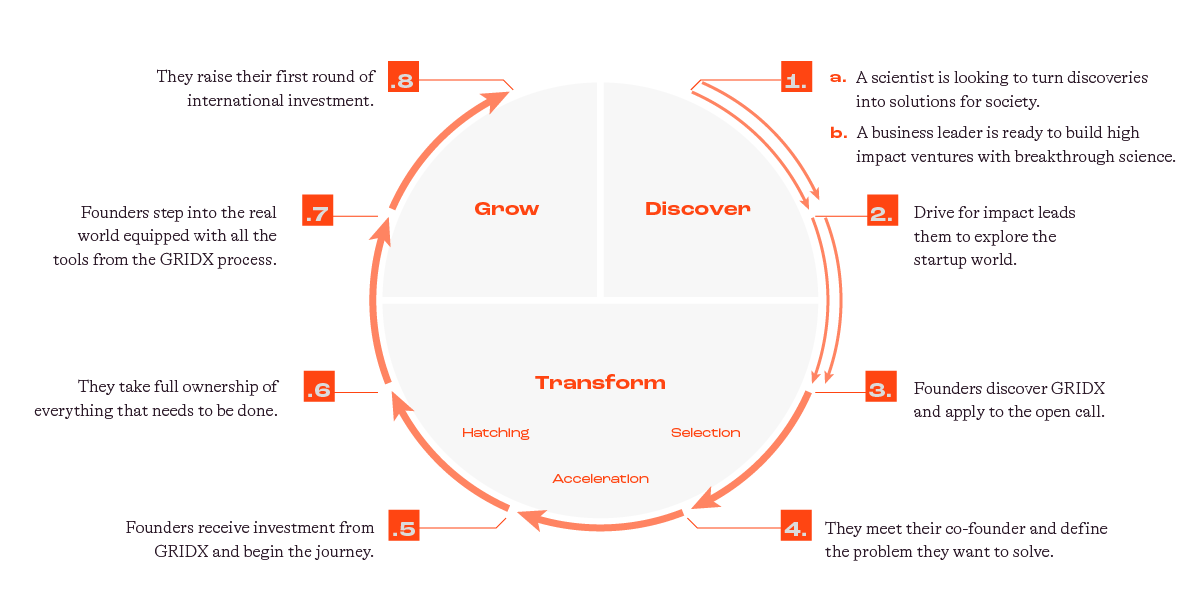
Along the founder’s journey, there comes a point where they step up to own everything the company needs. It doesn’t arrive printed on a business card. It is learned while building the company, and our support only makes sense if it fosters that learning. Knowing when to lean in and when to take a step back is a balance we are still figuring out.
Autonomy needs an ecosystem
The responsibility rests with the team, but many of the capabilities it needs lie outside. A science-based company connects with research institutions, specialists, buyers, and investors, and what it can accomplish with its technology depends partly on who it gets to know.
Hence, this journey treats tech transfer, commercial partnerships, and access to capital as indivisible components of the same build. An agreement with an institution can establish clear terms for developing a technology. An investor with experience in that specific application can grasp a risk that another wouldn’t know how to evaluate.
That is why we actively take our teams to learn from and within other ecosystems: so they can connect with people and organizations capable of helping them take the next step, and benchmark their value propositions against companies already competing in those markets. That exposure fundamentally shifts how a team understands its own opportunity.
Our relationship with SOSV (formerly IndieBio) is part of this story. We connected in 2015, and two years later, Beeflow became the first Argentine company accepted into their program. Later, Stämm, CASPR, Michroma, Puna Bio, Bioeutectics, and OncoPrecision went through it. Today, 14 startups from our portfolio have been selected. Each journey has added valuable experience on how to connect regional science with global development and investment networks.
That learning also circulates among founders. Some challenges are worked through differently with someone who just lived through them: how to prepare for an investor meeting, how to structure a growing team. A community ensures that what one company learned remains accessible to the next.
Here we see a direct connection to our reflections on the BIO ecosystem. Its capacity to grow depends, among other things, on each company finding fertile ground to develop. Relationships, shared experience, and access to specialized resources improve those conditions. Gaining autonomy involves learning to leverage that network and, over time, giving back to it. A network of individuals and companies that barely existed 10 years ago and now exists because we built, cultivated, and nurtured it—today representing one of our greatest sources of pride, as well as a tangible strategic advantage.
Deep tech, deep team
Together, these decisions offer a more tangible sense of what putting founders at the center really means. It starts by scouting talent that does not yet see itself as entrepreneurial. It continues with assembling founding teams and developing their discernment. And it is sustained by capital, relationships, and a community that expands what the team can dare to attempt.
Over the years, we’ve watched teams pivot on their market, their business model, their customer, or their scale. Some of those pivots saved the company.
A deep team, as we see it, is not a team that never changes. It is one that can change without losing the engine of its strength. Building it takes time and requires looking at things that technical due diligence, however rigorous, cannot reveal: how members collaborate, what shared ambition drives them, and how they navigate their differences.
What we learned is that when these teams click, their possibilities are boundless. Striking that balance between partners who recognize each other as complementary and essential makes all the difference.
The opportunity we discuss in this series requires more people capable of undertaking this journey from Latin America, and it calls for sharing what we learn about how to support them. Ten years in, we have a practice we can explain, debate, and refine alongside others. Open questions remain, such as how to support more teams without losing close contact, and what kind of capital best understands the runway needed for scientific validation.
We started out looking for science that could become companies. Today, we look for the people who can build the teams capable of driving that transformation.
We started out looking for science that could become companies. Today, we look for the people who can build the teams capable of driving that transformation.
Science remains the starting point. How far it goes depends on the team behind it.

Subscribe and get more insights from a decade building in bio.
© Grid Exponential
All rights reserved.
Teodoro García 2474, Buenos Aires, Argentina